About me

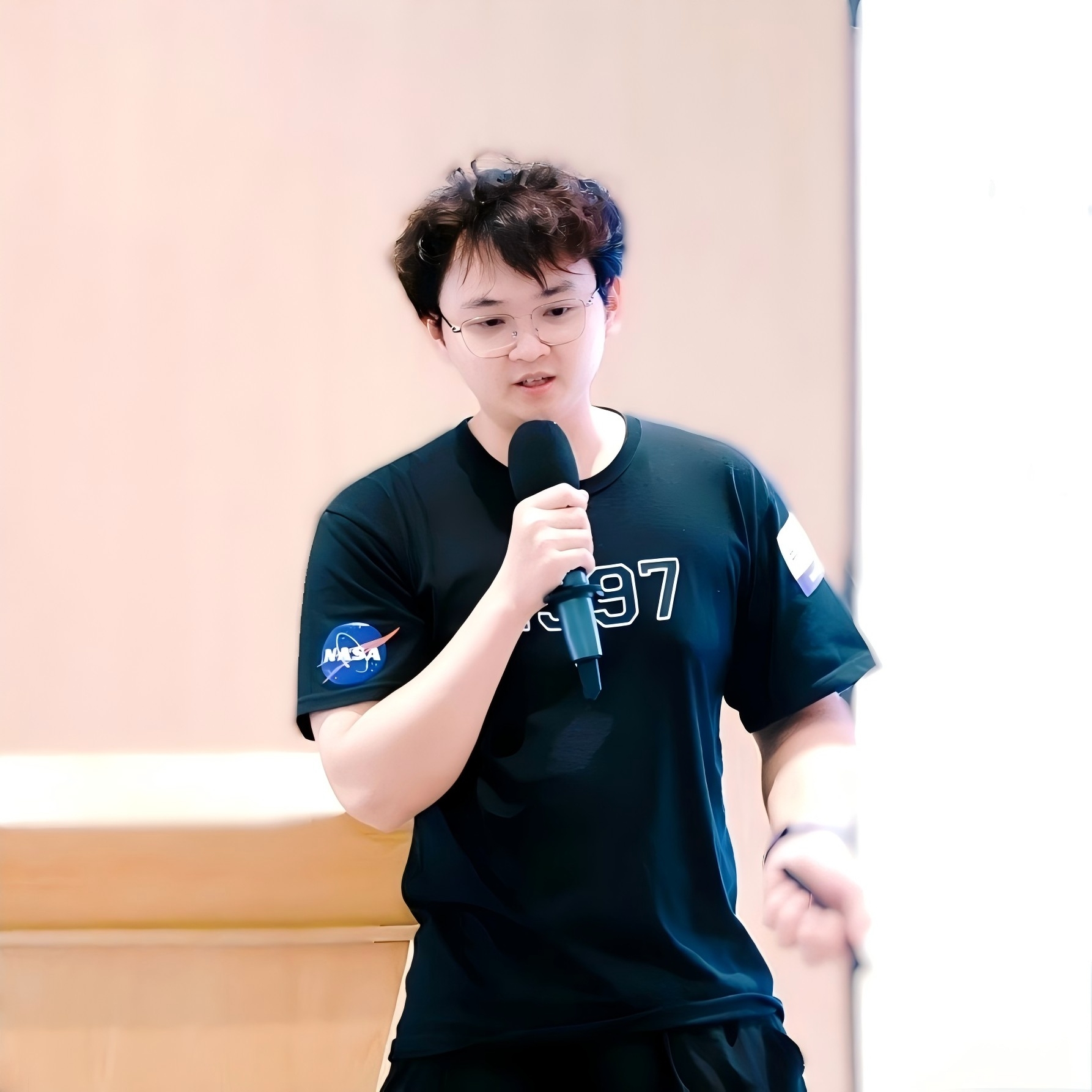
Junjie Wang (王军杰) is currently a postdoctoral researcher at the IIGROUP Lab, Tsinghua University, supervised by Prof. Yujiu Yang. His research focuses on Learning to Reason for Self-Evolving Agents, spanning knowledge-grounded reasoning in foundation models, interaction-based reasoning in digital agents, and physical-world reasoning in embodied agents. He received his Ph.D. in Engineering from Waseda University, under the supervision of Prof. Tetsuya Sakai.
Email: wangjunjie@sz.tsinghua.edu.cn (Please state your purpose / 请您注明来意)
📰 News / 最近
- [09/2026] 📜 3 papers are accepted to NeurIPS 2026!
- [08/2026] 📜 8 papers are accepted to EMNLP 2026 !
- [06/2026] 🏅 Selected as an ICML 2026 Golden Reviewer.
- [04/2026] 📜 1 paper is accepted to ICML 2026 !
- [04/2026] 📜 2 papers are accepted to ACL 2026 !
- [03/2026] 📜 1 paper is accepted to TMLR ! 获选CAAI-腾讯犀牛鸟研究计划 !
- [01/2026] 🎉 ROCO@AAAI2026 决赛冠军: URL
- [01/2026] 📜 1 paper is accepted to ICLR 2026 !
- [11/2025] 📜 1 paper (Oral) is accepted to AAAI 2026 !
🌌 Research Vision / 研究愿景
Learning to Reason: From Knowledge to Interaction to Physical Intelligence
学会推理:从知识驱动,到交互驱动,再到物理世界智能
My central question is: How can reasoning become a continually improving capability? I study a progression from knowledge-grounded reasoning to interaction-based reasoning and physical-world reasoning, with decreasing reliance on human-defined knowledge and increasing agent-driven information acquisition.
我的核心问题是:如何让推理成为一种能够持续改进的能力? 我关注从知识驱动推理、交互驱动推理到物理世界推理的演进:对人类预定义知识的依赖逐步减少,智能体通过交互主动获取信息的能力逐步增强。
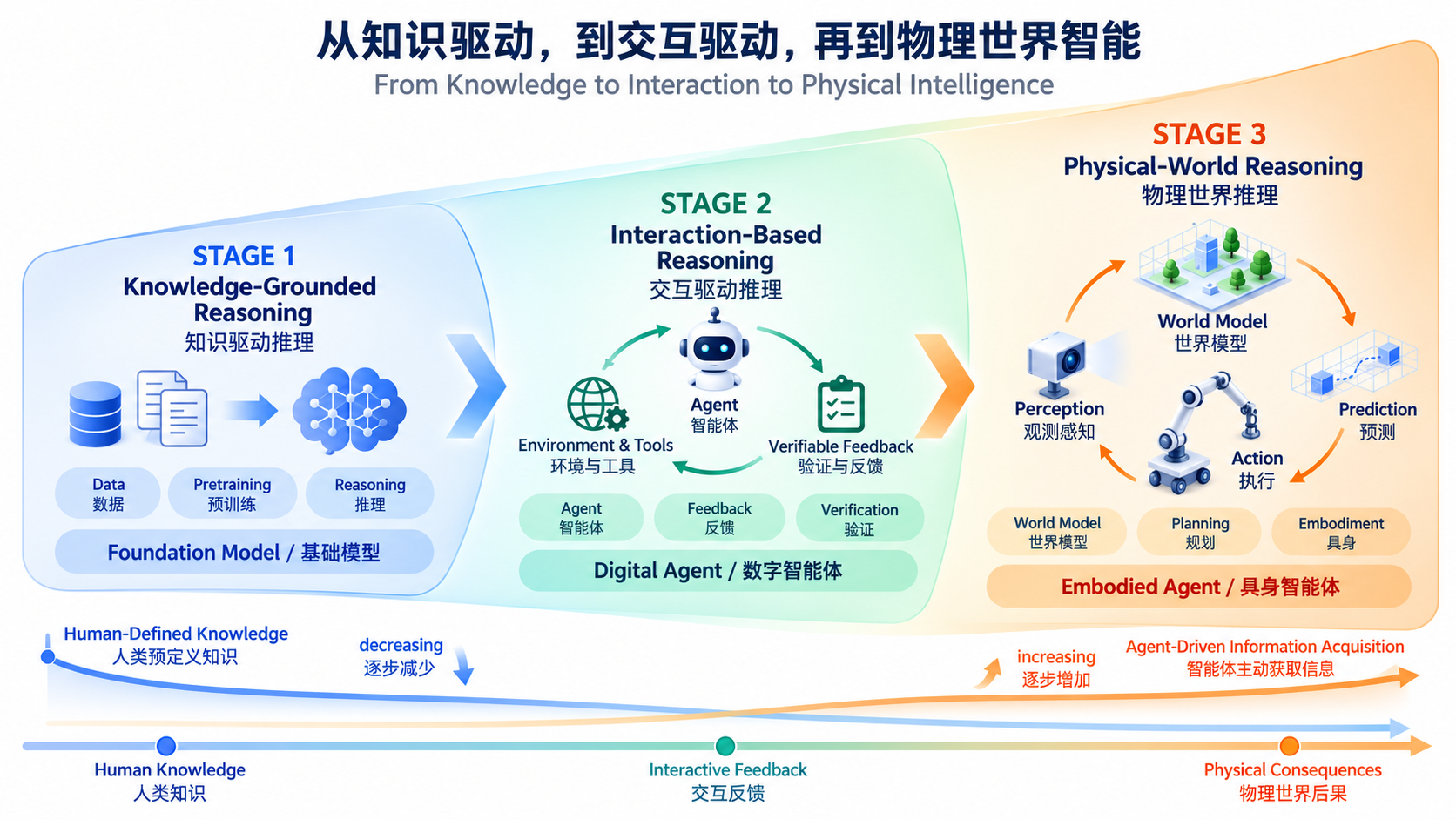
From foundation models to digital agents and embodied agents: human knowledge → interactive feedback → physical consequences.
从基础模型,到数字智能体,再到具身智能体:人类知识 → 交互反馈 → 物理世界后果。
🧭 Three Stages of Reasoning / 推理的三个阶段
Knowledge-Grounded Reasoning / 知识驱动推理 — Develop reasoning capabilities in foundation models through pretraining on human-curated data and knowledge.
通过在人类整理的数据与知识上进行预训练,发展基础模型的推理能力。Interaction-Based Reasoning / 交互驱动推理 — Enable digital agents to actively acquire information through environments and tools, verify feedback, and turn interaction experience into capability improvements.
让数字智能体通过环境与工具主动获取信息、验证反馈,并将交互经验转化为能力提升。Physical-World Reasoning / 物理世界推理 — Enable embodied agents to connect perception, world modeling, prediction, and action, using planning and physical consequences to inform subsequent decisions.
让具身智能体将感知、世界建模、预测与行动形成闭环,通过规划指导行动,并根据物理世界中的行动后果调整决策。
🔄 Toward Reasoning-Centric RSI / 迈向以推理为中心的 RSI
Interaction → Verification → Attribution → Internalization → Capability Improvement ↺
My long-term goal is Reasoning-Centric Recursive Self-Improvement (RSI): agents that can verify which experiences are trustworthy, attribute success and failure, internalize high-value lessons, and eventually improve the mechanisms by which they improve.
我的长期目标是构建以推理为中心的递归自我改进(Reasoning-Centric RSI):让智能体能够验证经验、归因成败、内化高价值反馈,并最终改进其自身的改进机制。
✒️ Recent Professional Services / 最近的专业服务
- Golden Reviewer: ICML 2026
- Area Chair: ACL ARR 2025 October (EACL); ACL ARR 2026 January (ACL); ACL ARR 2026 March (EMNLP).
- Senior PC member: WSDM 2026
- Workshop Organiser: SIGIR-AP 2025 BREV-RAG Workshop
Publications
Details in Publications Page
Total Publications: 40
- ⭐: Co-first Author
- 🚩: Corresponding Author
- 💭: Under Review